Saeed A. Chowdhry, MD
Traumatic injuries are, by definition, unplanned and undeserved. The patients we care for did not choose their circumstances, yet they must live with the consequences long after the acute phase has passed. As reconstructive surgeons, our responsibility extends beyond simply achieving wound closure. We owe it to our patients to pursue restoration of form, function, and identity as closely as possible to their pre-injury state.
Over the course of my career, I have become increasingly aware that reconstructive surgery is not solely about technical execution, but about understanding and leveraging the body’s innate capacity to heal. Advances in regenerative medicine, particularly autologous cell–based approaches, have meaningfully expanded what is possible in this regard. These therapies do not replace established reconstructive techniques such as skin grafts or flaps, but they have begun to change how and when we use them—and what level of outcome we should expect.
Trauma reconstruction: Raising the bar
In trauma reconstruction, success has historically been measured by durable coverage and limb salvage. While these goals remain essential, they are no longer sufficient. Survivors of traumatic injury must live with their reconstruction for decades. The quality of that reconstruction—how it looks, moves, scars, and integrates—matters profoundly.
Traditional paradigms often accept significant donor-site morbidity, wide mesh ratios, color mismatch, and contour irregularities as unavoidable tradeoffs. Increasingly, I believe we should challenge that assumption. With modern adjuncts, it is possible to aim higher without compromising reliability.
Quality matters: The STSG inflection point
One of the most meaningful opportunities to improve outcomes lies at the timing of split-thickness skin grafting. This is a critical decision point: the wound bed has declared itself, reconstruction is imminent, and choices made here directly influence donor-site burden, graft quality, and long-term aesthetics.
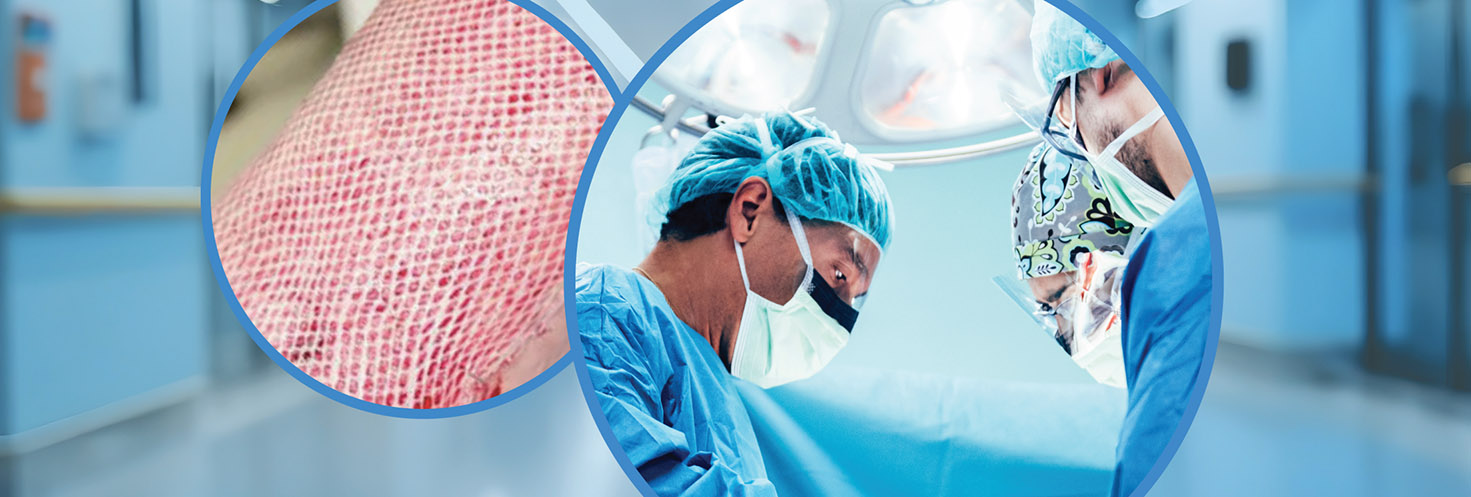
By enhancing epithelialization and promoting more uniform healing, these approaches can support wider mesh ratios while maintaining acceptable—and often surprisingly favorable—cosmesis. This directly translates to smaller donor sites, faster donor-site healing, and less overall morbidity for the patient.
In appropriately selected traumatic wounds, integrating autologous cell-based therapies at the time of grafting has allowed me to rethink several long-held constraints. By enhancing epithelialization and promoting more uniform healing, these approaches can support wider mesh ratios while maintaining acceptable—and often surprisingly favorable—cosmesis. This directly translates to smaller donor sites, faster donor-site healing, and less overall morbidity for the patient.
For trauma patients already coping with physical and psychological injury, reducing donor-site pain and scarring is not a minor benefit. It is a meaningful improvement in their recovery experience.
Restoration, not just coverage
What has been most striking in my experience is not simply faster healing, but the quality of healing. In traumatic reconstructions involving large grafted surfaces or complex interfaces between grafts and flaps, I have observed more seamless transitions, improved pigmentation blending, and surfaces that more closely resemble native skin.
These improvements do not eliminate the need for sound surgical judgment or meticulous technique. Rather, they amplify the results of good reconstruction. A graft that once healed with stark textural contrast may now integrate more smoothly. A reconstruction that previously prioritized durability alone can now better address appearance and confidence.
This shift is particularly important in visible or socially sensitive areas, where aesthetic outcome has real implications for reintegration, self-image, and quality of life.
Reframing the reconstructive goal
Reconstructive surgery has always been about restoring form and function, but trauma care has often been forced to accept compromise. Regenerative strategies give us the opportunity to revisit those compromises. They encourage us to ask not only can the wound be closed, but how well can we restore what was lost?
Importantly, this evolution does not require abandoning established reconstructive principles. Flaps, grafts, and staged reconstruction remain foundational. What is changing is our ability to influence biology in a way that supports better outcomes from these tools.
Looking forward
At present, autologous cell-based therapies primarily influence re-epithelialization. Looking ahead, the potential to extend regenerative strategies into predictable dermal restoration is compelling. Current dermal substitutes can be effective, but they do not fully replicate the elasticity, resilience, or functional characteristics of native skin.
If future advances allow for more complete regeneration such as improving elasticity, reducing contracture, and restoring more natural skin behavior, the implications for trauma reconstruction would be profound. Such progress would further shift our focus from survival and coverage toward true restoration.
History reminds us that many advances once viewed as aspirational eventually become standard. Microsurgical reconstruction itself followed this path. Regenerative medicine appears to be on a similar trajectory.
Conclusion
Traumatic injury changes lives in an instant. As reconstructive surgeons, we cannot undo the event, but we can influence what follows. By thoughtfully integrating regenerative approaches into trauma reconstruction, particularly at pivotal moments such as skin grafting, we can reduce donor-site burden, improve aesthetic and functional outcomes, and better honor our obligation to patients who are victims of circumstance.
Closing the wound is no longer the finish line. Restoration should be.
Looking for more like this? Read Beyond Closing Wounds: The Science of Restoring Form and Function or “Reseeding” Wounds: Fast-Track Healing and Skin Renewal.
About the author
Saeed A. Chowdhry, MD has a busy clinical practice in the Chicago area and also serves as Associate Professor of Plastic Surgery at the Rosalind Franklin University of Medicine and Science, also known as The Chicago Medical School. Dr. Chowdhry is the Chairman and Chief of Plastic Surgery at Christ Hospital in the Chicago area. With close to 800 beds, it is one of the busiest Level I trauma centers and tertiary care referral centers in the Midwest.
He was Educated at Rush University College of Medicine and subsequently completed his General Surgery training at the University of Illinois at Mt. Sinai and Plastic Surgery fellowship training at the University of Louisville. While in training and in practice he has won several research and teaching awards. He has authored peer reviewed journal articles and book chapters that have been reviewed and cited over a thousand times in the surgical literature. Dr. Chowdhry has also served as a reviewer for several journals as well as the Cochrane Review and has been recognized for his expertise in reconstructive and cosmetic surgery.
The views and experiences described above are the author’s own and may or may not reflect those of AVITA Medical.