

Explore the Science Driving Innovation in Wound Healing
At AVITA Medical, science is central to everything we do. Our portfolio is built on a foundation of peer-reviewed research and real-world clinical experience. We are advancing evidence that supports better care in skin restoration, from well-established research supporting RECELL® to emerging clinical data around our next-generation disruptive technologies.
For inquires about our published evidence, please contact the AVITA Medical customer service team at 833-462-8482, or complete our contact us form.
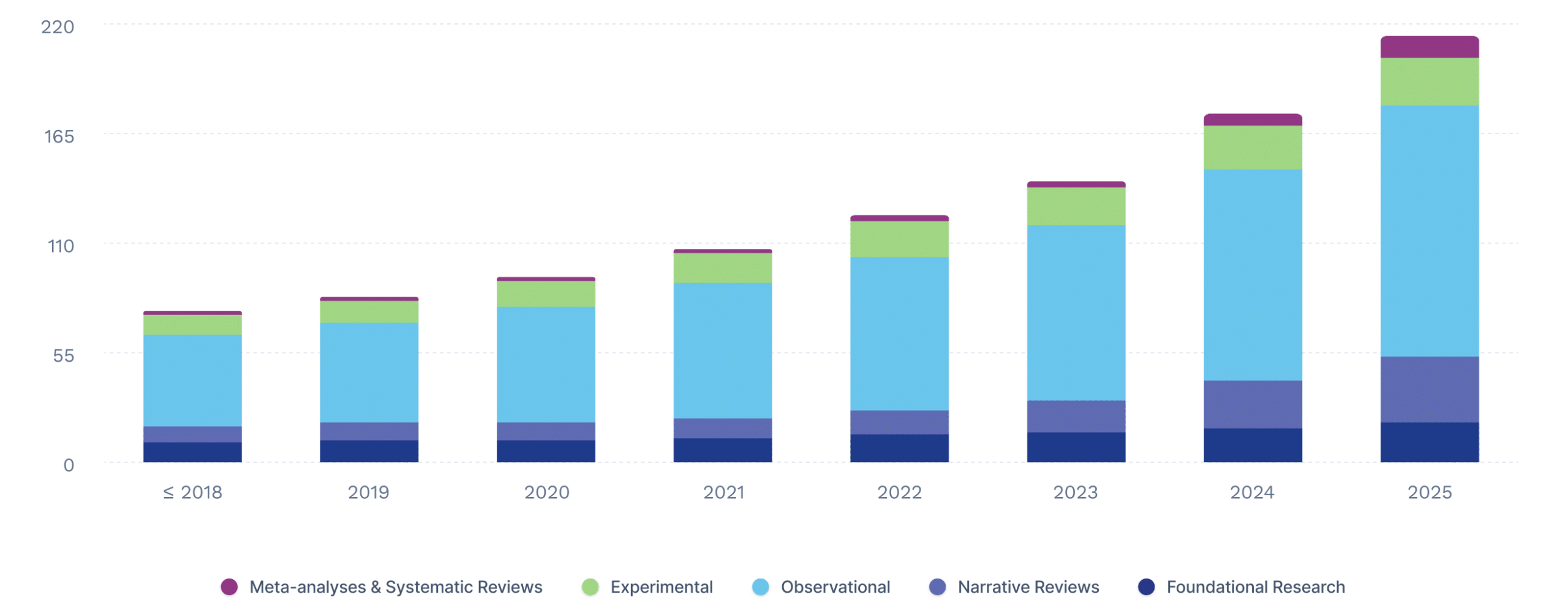
AVITA Portfolio Publications
Cumulative Count by Study Design
Key peer-reviewed publications
| Title | Authors (Journal, Year) | Study Design | Indication | Summary of Evidence |
|---|---|---|---|---|
| Autologous skin cell suspension for full-thickness skin defect reconstruction: Current evidence and health economic expectations | Kahn et al. | Narrative Review | Surgical & traumatic wounds |
This article discusses the cost benefits that may be anticipated with the use of RECELL for surgical & traumatic full-thickness wounds. Read it here : Autologous skin cell suspension for full-thickness skin defect reconstruction: Current evidence and health economic expectations (opens in a new tab) |
| Biological attributes required for epidermal regeneration: Evaluation of the next-generation autologous cell harvesting device | Bush et al. | Foundational Research | – |
The RECELL GO device aids in the preparation of a comparable skin cell suspension to the previous device with improved standardization and reduced variability in cell count. Read it here : Biological attributes required for epidermal regeneration: Evaluation of the next-generation autologous cell harvesting device (opens in a new tab) |
| Maximizing wound coverage in full-thickness skin defects: A randomized-controlled trial of autologous skin cell suspension and widely meshed autograft versus standard autografting | Henry et al. | Experimental (Randomized Controlled Trial) | Surgical & traumatic wounds |
In patients with nonthermal full-thickness wounds, treatment with RECELL plus widely meshed autograft significantly reduced donor skin requirements by 27% compared to less widely meshed autografting. Read it here : Maximizing wound coverage in full-thickness skin defects: A randomized-controlled trial of autologous skin cell suspension and widely meshed autograft versus standard autografting (opens in a new tab) |
| Wound healing and scar patterning after addition of autologous skin cell suspension to meshed grafts | Collins et al. | Foundational Research | Surgical wounds |
In porcine full-thickness wounds treated with 3:1 meshed autograft, the addition of RECELL significantly increased rate of re-epithelialization of interstices at early time points. Read it here : Wound healing and scar patterning after addition of autologous skin cell suspension to meshed grafts (opens in a new tab) |
| Analysis of real-world length of stay data and costs associated with use of autologous skin cell suspension for the treatment of small burns in U.S. centers | Carson et al. | Observational | Burns |
Use of RECELL for small burns (<20% TBSA) in U.S. centers was associated with an average 2.1 day reduction in length of stay, translating to a $22,268 cost savings per patient. Read it here : Analysis of real-world length of stay data and costs associated with use of autologous skin cell suspension for the treatment of small burns in U.S. centers (opens in a new tab) |
| Length of stay and costs with autologous skin cell suspension versus split-thickness skin grafts: Burn care data from US centers | Carter et al. | Observational | Burns |
Use of RECELL for burns up to 50% TBSA in U.S. centers was associated with an average 3.3 day reduction in length of stay, translating to a $36,949 cost savings per patient. Read it here : Length of stay and costs with autologous skin cell suspension versus split-thickness skin grafts: Burn care data from US centers (opens in a new tab) |
| Cost-effectiveness of the use of autologous cell harvesting device compared to standard of care for treatment of severe burns in the United States | Kowal et al. | Foundational Research | Burns |
Economic models demonstrate that hospital length of stay accounts for up to 70% of cost reductions, with estimated per-patient savings ranging from $31,000 to over $150,000, and projected annual savings of $5.3 to $6.8 million for a representative U.S. burn center treating 200 patients. Read it here : Cost-effectiveness of the use of autologous cell harvesting device compared to standard of care for treatment of severe burns in the United States (opens in a new tab) |
| Demonstration of the safety and effectiveness of the RECELL® System combined with split-thickness meshed autografts for the reduction of donor skin to treat mixed-depth burn injuries | Holmes et al. | Experimental (Randomized Controlled Trial) | Burns |
In patients with mixed-depth burns (inclusive of full-thickness), treatment with RECELL plus widely meshed autograft significantly reduced donor skin requirements by 32% compared to less widely meshed autografting. Read it here : Demonstration of the safety and effectiveness of the RECELL® System combined with split-thickness meshed autografts for the reduction of donor skin to treat mixed-depth burn injuries (opens in a new tab) |
| A comparative study of the RECELL Device and autologous split-thickness meshed skin graft in the treatment of acute burn injuries | Holmes et al. | Experimental (Randomized Controlled Trial) | Burns |
In patients with deep partial-thickness burns, treatment with RECELL alone significantly reduced donor skin requirements by 97.5% compared to 2:1 meshed autografting. The RECELL donor site resulted in significantly less pain, faster healing, and improved patient satisfaction. Read it here : A comparative study of the RECELL Device and autologous split-thickness meshed skin graft in the treatment of acute burn injuries (opens in a new tab) |
| A comparative study of spray keratinocytes and autologous meshed split-thickness skin graft in the treatment of acute burn injuries | Sood et al. | Experimental (Randomized Controlled Trial) | Burns |
In patients with partial-thickness burns, treatment with RECELL alone resulted in decreased donor size and comparable healing outcomes compared to meshed autografting alone. Read it here : A comparative study of spray keratinocytes and autologous meshed split-thickness skin graft in the treatment of acute burn injuries (opens in a new tab) |
| Sprayed keratinocyte suspensions accelerate epidermal coverage in a porcine microwound model | Navarro et al. | Foundational Research | Surgical wounds |
In porcine full-thickness wounds treated with 3:1 meshed autograft, the addition of RECELL resulted in faster and better quality of epithelialization at the cellular level. Read it here : Sprayed keratinocyte suspensions accelerate epidermal coverage in a porcine microwound model (opens in a new tab) |
| Title | Authors (Journal, Year) | Study Design | Indication | Summary of Evidence |
|---|---|---|---|---|
| A randomized, controlled trial comparing PermeaDerm® to Mepilex Ag® in the treatment of adult and pediatric partial-thickness burns | Greenhalgh et al. | Experimental (Randomized Controlled Trial) | Burns |
In (mostly pediatric) patients with partial-thickness burns, treatment with PermeaDerm significantly reduced the odds of needing a dressing change compared to Mepilex Ag. Read it here : A randomized, controlled trial comparing PermeaDerm® to Mepilex Ag® in the treatment of adult and pediatric partial-thickness burns (opens in a new tab) |
| Initial experience using a biosynthetic wound matrix for full-thickness wound temporization | Akpunonu et al. | Observational | Surgical wounds |
PermeaDerm performed as a viable option for temporizing full-thickness wounds, The authors concluded that PermeaDerm is an effective alternative to allograft, delivering similar clinical outcomes while offering advantages like simplified storage, reduced cost, easier application, and optimized management. Read it here : Initial experience using a biosynthetic wound matrix for full-thickness wound temporization (opens in a new tab) |
| Use of a bioactive matrix glove in the treatment of pediatric hand burns: a case series | Julian et al. | Observational | Burns |
In pediatric patients with partial-thickness hand burns, the PermeaDerm glove resulted in successful healing with minimal scarring, preserved joint mobility, and minimal need for dressing changes. Read it here : Use of a bioactive matrix glove in the treatment of pediatric hand burns: a case series (opens in a new tab) |
| Preliminary study of wound oxygenation comparing skin substitutes and dressings | Woodroof et al. | Foundational Research | – |
PermeaDerm transferred oxygen significantly faster than Integra® Dermal Regeneration Template and NovoSorb™ Biodegradable Temporizing Matrix, suggesting its potential to enhance wound healing by improving oxygenation delivery. Read it here : Preliminary study of wound oxygenation comparing skin substitutes and dressings (opens in a new tab) |
| Evaluating a variable porosity wound dressing with anti-scar properties in a porcine model of wound healing | Woeller et al. | Foundational Research | Surgical wounds |
In full-thickness porcine wounds, those treated with PermeaDerm healed more effectively and showed potential to reduce excessive scar formation compared to those not treated. Read it here : Evaluating a variable porosity wound dressing with anti-scar properties in a porcine model of wound healing (opens in a new tab) |
| In vitro characterization of variable porosity wound dressing with anti-scar properties | Woeller et al. | Foundational Research | – |
PermeaDerm supported cell growth and reduced scar-associated myofibroblast formation and inflammatory cytokines. Read it here : In vitro characterization of variable porosity wound dressing with anti-scar properties (opens in a new tab) |
| Evolution of a temporary biosynthetic skin substitute: A preliminary study | Woodroof et al. | Foundational Research | Surgical wounds |
PermeaDerm demonstrated better control of inflammation, reduced scarring markers, and superior cell growth and migration compared to Biobrane®. Read it here : Evolution of a temporary biosynthetic skin substitute: A preliminary study (opens in a new tab) |
| Title | Authors (Journal, Year) | Study Design | Indication | Summary of Evidence |
|---|---|---|---|---|
| A bovine dermal collagen matrix (BDCM) advances readiness to autografting: A case series | Akpunonu et al. | Observational | Surgical wounds |
Cohealyx supported wound bed vascularization within 5-10 days, demonstrating its clinical potential as a dermal matrix option to support timely graft-readiness. Read it here : A bovine dermal collagen matrix (BDCM) advances readiness to autografting: A case series (opens in a new tab) |
| Bovine Dermal Collagen Matrix for Early Graft Readiness in a Full-Thickness Posterior Neck Burn: A Case Report | Gibson et al. | Observational | Surgical wounds |
Cohealyx supported graft readiness of a full-thickness neck injury in 12 days, demonstrating its clinical potential to support definitive closure with excellent clinical performance and conformability in complex anatomical locations. Read it here : Bovine Dermal Collagen Matrix for Early Graft Readiness in a Full-Thickness Posterior Neck Burn: A Case Report (opens in a new tab) |
| Bovine dermal collagen matrix promotes vascularized tissue generation supporting early definitive closure in full-thickness wounds: A pre-clinical study | Bush et al. | Foundational Research | Surgical wounds |
In full-thickness porcine wounds, Cohealyx supported rapid cellular infiltration and vascularized tissue formation, supporting autograft readiness at Day 7 and earlier definitive closure compared to Integra® Bilayer Wound Matrix and Kerecis®. Read it here : Bovine dermal collagen matrix promotes vascularized tissue generation supporting early definitive closure in full-thickness wounds: A pre-clinical study (opens in a new tab) |