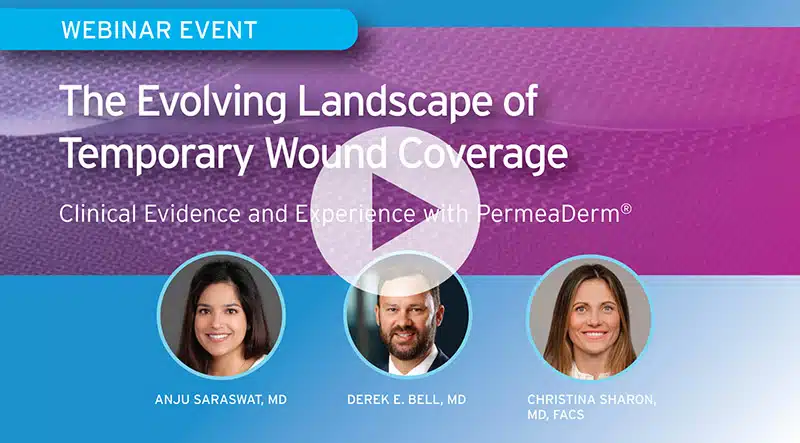
Human cadaveric allograft has long been used to provide temporary coverage prior to autografting; however, availability, cost, storage, and preparation time can pose limitations. This webinar explored the role of PermeaDerm, a temporary biosynthetic wound matrix, as a lower cost alternative to allograft. The session featured results from the PermeaDerm-I randomized controlled trial, including clinical outcomes, financial impact, and histological evaluation. Attendees gained perspective on how PermeaDerm supports wound temporization, offering a resource-conscious approach in staged wound management. Recorded date: August 20, 2026
Presenters:
- Anju Saraswat, MD, Assistant Medical Director, Burn Center, Department of Surgery, Wake Forest School of Medicine, Winston-Salem, NC
- Christina Sharon, MD, FACS, Burn Director, Baton Rouge Regional Burn Center, Baton Rouge, LA
- Derek E. Bell, MD, Professor of Plastic Surgery, Professor of Orthopaedic Surgery, Kessler Burn Director, University of Rochester Medical Center, Rochester, NY
Watch it on demand here:
Read the full transcript here:
Karen Winn, MSN, ACNP, RN
Good afternoon and welcome to today’s webinar, The Evolving Landscape of Temporary Wound Coverage, Clinical Evidence and Experience with PermeaDerm. Today’s discussion will explore the evolving role of temporary wound coverage, including clinical evidence from the PermeaDerm randomized control trial and perspectives in wound temporization and staged wounds management.
We are pleased to be joined by three highly experienced burn surgeons. Our first speaker is Dr. Anju Saraswat, Assistant Professor of Surgery at Wake Forest School of Medicine and Assistant Medical Director of the Burn Center. Dr. Saraswat completed her general surgery residency at Riverside Methodist Hospital, followed by our fellowship training in acute and reconstructive burn surgery at UC Davis and surgical critical care at UCSF Fresno. She’s board certified in both general surgery and surgical critical care and is actively involved in burn research, education, and national clinical trials.
Next, we will hear from Dr. Derek Bell. He’s professor of surgery, the Division of Plastic Surgery and Reconstructive Surgery and professor of orthopedic surgery at the University of Rochester Medical Center, where he serves as the medical director of the Kessler’s Family Burn Center and Kesslers Burn Unit. Dr. Bell completed his general surgery residency at State University of Buffalo, followed by a fellowship in plastics and reconstructive surgery at the University of Virginia. His clinical experience and research interests include burn surgery, complex wound management, reconstructive, surgery and regenerative medicine.
Our final speaker is Dr. Christina Sharon. She’s the Medical Director of the Baton Rouge Burn Center, Regional Burn Center and Acute Care and Burn Surgeon at Baton Rouge General Medical Center. Dr. Sharon completed her general surgery residency at the Brooklyn Hospital, followed by a fellowship training in burn surgery at Jacoby Medical Center, Albert Einstein College of Medicine and Trauma and Surgical Critical Care at Westchester Medical Center. She is board certified in general surgery and surgical critical care and is particularly interested in optimizing functional and cosmetic outcomes for burn patients while minimizing donor site morbidity.
We are very fortunate to have their collective expertise with us today. And with that, I’ll turn the program over to Dr. Saraswat to begin our discussion.
Anju Saraswat, MD
These are our disclosures of the following cases. They’re our own experience. All of us are medical advisors for AVITA. AVITA has built a portfolio that is capable of supporting a wound bed through all stages of injury to healing.
These three technologies are often used in a complementary way across the stages of treatment. First is PermeaDerm. This is a product that is used to protect and stabilize a wound bed prior to autograft placement. Cohealyx is a collagen dermal matrix that is placed on a wound bed. It’s a scaffold for tissue growth and repair of structural defects, again, prior to autograft placement. And finally, RECELL, which is a point-of-care, donor-sparing autologous spray-on-skin technology that is used during the final stage of autografting and shortens time to healing and restoration of the skin barrier.
Today we will be focusing on PermeaDerm for temporary wound coverage. So what is temporization and why do we utilize this strategy in staged wound care? Temporization, simply put, is in the phase of a wound bed that is fully excised, but not necessarily ready for a skin graft. The patient may require further stabilization, the wound bed viability may be uncertain, or perhaps the donor skin is limited and re-harvesting is a limiting agent. This is where temporization comes into play, requiring something that is able to protect and maintain an ideal environment for the wound bed while factors prior to autografting are corrected.
PermeaDerm provides temporary wound coverage that helps bridge the period between excision and definitive closure while maintaining a protective environment until reconstruction can proceed. This clinical role is central to the PermeaDerm I study we’ll discuss today and reflects how the product is increasingly being positioned in practice as an alternative to allograft during this stage of care.
Cadaveric allografts have been used for temporary wound coverage for more than a century and remain an effective and familiar option in burn care when definitive closure is not yet possible. While widely used, allograft requires frozen storage, tissue tracking, thawing before application, and sometimes meshing of the allograft, all of which add time and complexity while the patient is in the operating room. In addition, because they are human-derived, they also carry a risk of transmission and immunogenic response.
PermeaDerm is a modern approach to temporization. It is a biosynthetic wound matrix designed to provide temporary coverage, similar to allograft, but it reduces the logistical burden of the human donor tissue. PermeaDerm mimics key features of native skin through a bilayer structure that protects the wound. It allows oxygen exchange and supports healing. Again, it’s fully removed prior to definitive closure, making it a temporary bridge rather than a permanent implant. This product is also transparent, which allows at-a-glance wound assessment with a clear view to the wound healing process, allowing timely interventions and efficient operative plans.
The purpose of the study was to determine whether PermeaDerm could address this need as an alternative to allograft. Surgeons need a temporary wound coverage option that bridges excision and definitive grafting in medically complex burn patients. The PermeaDerm I study was a randomized control trial in 40 patients with wounds requiring staged excision and grafting and sustained a lesser than equal to 30% TBSA injury. Patients received PermeaDerm or allograft during the temporization period.
They were assessed every two to three days prior to split thickness skin grafting and were subsequently followed for eight weeks. Key end points were related to safety and efficacy, which included graft take, healing time, inflammatory profile, adverse events, and satisfaction of both the patient and provider.
A second endpoint evaluated cost and workflow, which involved cost per TBSA treated, preparation and application time, re-applications, and wear time. Collectively, 11 burn centers contributed data to the study and are listed here on the slide. The participation of multiple investigators across diverse institutions and patient populations help demonstrate that these findings are representative of real world burn and wound care rather than the experience of a single burn center.
Once enrolled, patients were randomized to receive PermeaDerm or allograft as a temporary coverage. During the temporization period, patients returned every two to three days for dressing changes and wound assessments to monitor progress. When the wound was ready for autograft placement, biopsies were obtained for histology, the temporizing agent was removed and split thickness skin grafting was applied. Patients were then followed through week eight of their post-operative course, evaluating clinical outcomes, safety, and satisfaction.
This summarizes the baseline characteristics of the cohort, which paralleled a typical burn population. Although the study was randomized, the true groups were not perfectly balanced at baseline. The allograft group had a higher proportion of male patients, a larger TBSA burn size, and a higher proportion of patients in the ASA to a three to four classification. These are important in context for interpreting outcomes that may be influenced by these factors. An adjusted analysis of burn size in ASA class were performed on relevant outcomes, revealing no impact.
When evaluating the primary endpoint, PermeaDerm demonstrated a substantial product cost advantage when compared to allograft. Product cost per percentage of body surface area treated was $148.70 with PermeaDerm, versus approximately $500 with allograft, representing a reduction of $348.40 or approximately 70% per percent body surface are treated. This difference was statistically significant with a P-value of less than one one-thousandths. Normalizing cost by the percentage of body surface area treated allows for a more meaningful comparison across patients with different wound sizes. These findings provide high level evidence that PermeaDerm can materially reduce the product costs associated with temporary wound coverage compared with cadaveric allograft.
The economic advantage of Permeaderm was not limited to the product’s acquisition cost. The study also evaluated how each product moved through the treatment workflow. For product preparation, there was 30 minutes difference overall between PermeaDerm and allograft. Allograft requires tissue tracking, travel to the tissue bank, thaw time, and mesh time where PermeaDerm is readily shelf available and supply is predictable. For product application, we normalize this to per 100 centimeters squared, and we see that there is no statistical difference, and means are comparable.
These findings demonstrate that PermeaDerm savings may extend beyond product costs by reducing the operative time and complexity associated with applying products for temporary wound coverage. Surgeons temporize for different reasons, and PermeaDerm can support those varying temporization and workflow needs. In the study, PermeaDerm wear time ranged from three to 17 days, depending on the clinical need. During that timeframe, no patients required reapplication and no PermeaDerm-related adverse events were observed.
Additionally, when appropriate, patients in PermeaDerm were also able to be discharged prior to grafting, supporting the ability of PermeaDerm to facilitate outpatient management and hospital throughput. Histology was obtained after removal of either allograft or Permeaderm and prior to graft placement. Across the parameters assessed, granulation tissue, inflammatory infiltrate, blood vessel density, early collagen, mature collagen, and epithelialization, there were no meaningful differences between PermeaDerm and allograft.
The only histologic parameter that differed between the two groups was remaining product present in the wound bed, which was significantly lower for PermeaDerm. After product removal and wound bed cleaning, 55% of allograft-related subjects had residual allograft embedded within the wound bed compared with only one subject, which was 5%, in the PermeaDerm group with minimal remnant.
Investigators reported high satisfaction with PermeaDerm at the time of grafting, with 84% satisfied or very satisfied, and 16% reported a neutral state. This suggests that the product is well tolerated by patients and easy to incorporate into a surgeon’s operative workflow.
PermeaDerm demonstrated both a significantly lower product cost and a simpler application workflow. The next question is whether those advantages followed clinical outcomes. At week one following autograft placement, at least 95 percent graft take was achieved in approximately 94 percent of PermeaDerm patients and 95 percent of allograft patients. Wound closure trajectories were also favorable and statistically similar between two groups. Importantly, by week four, all patients in both groups had achieved at least 95 percent wound closure.
These descriptive findings provide important clinical reassurance. PermeaDerm’s economic and workflow advantages were achieved alongside favorable healing outcomes. As these products are used in medically complex burn patients, safety is an extremely important part of the study. Reassuringly, there were no PermeaDerm-related adverse events, and overall, adverse events were numerically lower with PermeaDerm than allograft, including fewer study area events.
Wound biopsies also showed no meaningful differences in inflammation between the groups. Overall, these findings support the safety of PermeaDerm as a temporary wound coverage option. Again, investigators and patients both reported high satisfaction with PermeaDerm, with 100% in each group rating it satisfied or very satisfied at week eight. That’s an important practical signal suggesting the product was well tolerated and easy to incorporate into clinical use.
The aggregate data we’ve reviewed is supported by what we observed in individual patients. This slide shows a comparative case example illustrating how PermeaDerm performed relative to allograft. These two patients were similar in age and had wounds with similar size, mechanism of injury, as well as wound location. Following excision of these full thickness burns down to hypodermis, both wounds required temporary coverage before autograft placement.
As you can see, both products provided effective wound protection throughout the first several days, while PermeaDerm provided the additional benefit of being transparent, allowing the surgeon to directly visualize the wound bed without removing the product. That visibility can make ongoing assessment easier while maintaining the wound coverage, a clear advantage for a temporizing agent.
This is the same comparative case on day four and five post-application product. You were able to easily evaluate the wound bed where PermeaDerm has been applied and also were able to see the vascularized viable wound bed indicating the wound is ready for grafting.
At week one, the PermeaDerm and allograft were removed and autograft was applied. The images on the right of the screen are eight weeks follow-up and demonstrate comparable healing outcomes. This representative case illustrates that PermeaDerm provided effective interim coverage in a manner that was clinically comparable to allograft, with the added practical advantage of visualization of the wound bed.
Taken together, the data suggests PermeaDerm delivered comparable clinical results with less workflow burden and lower cost. We saw comparable graft-take and healing, no difference in safety or the inflammatory profile, and high satisfaction from both surgeons and patients. From a practical standpoint, PermeaDerm also simplified workflow by eliminating thawing, meshing, and tissue bank logistics, while remaining easy to integrate into clinical protocols and available in predictable configurations. Economically, the product demonstrated a 70% reduction product cost per percent TBSA treated.
Together, these findings support PermeaDerm as a temporizing option with meaningful operational and economic advantages.
I’ll now pass over the presentation to Dr. Bell, who will be talking about his clinical experience with the product.
Derek E. Bell, MD
Thanks, Anju. To give the audience perspective, I have been in practice for the past 18 years and have taken care of a lot of our patients. I think that PermeaDerm is beginning to revolutionize how I take care of my patients. So I’m excited for the opportunity to share some of my patients with you and my thoughts on its utilization.
This is one of the first patients that I used PermeaDerm on. This is an 18-year-old gentleman that had a 1% grease burn to his foot. This is about two days after presentation. This is the type of person that I know is going to need a skin graft. However, the wound bed may not be reliable in this patient, given the mechanism of the burn and given that it’s along the dorsum of the foot, which is obviously some thinner skin and may continue to demark it with time. However, I don’t want to delay the time which I graft this, exposing a patient for prolonged wound healing or risk of infection. So this is a great case for me to put the PermeaDerm on.
Here’s the patient in the operating room. This was applied as an outpatient and the patient was subsequently discharged to home. Also, this allows me to buy some time because I hate grafting toes, if I can avoid that. So I was hoping that the toes would go on to heal over the course of the next week or two while we had the Permeaderm in place over the larger area of wounds.
Here he is at 14-days post-application. This is after removal of the PermeaDerm and re-excision of the wound bed. What I’ve noticed from its utilization is that the wound beds are very, very robust and bleeding nicely. And also, as Dr. Saraswat alluded to, I know when the wound beds are going to be ready for grafting because the product is translucent, so there’s no guessing. With the appearance of the allograft I’ve used previously, sometimes I would touch it to see if it’s adherent, but sometimes this becomes white and you can’t really see what’s going on beyond the interstices of the allograft. So this is nice in this regard. This is a gentleman I probably could have grafted at a week instead of two weeks. Fortunately his toes did heal in so I didn’t have to graft his toes. I applied a sheet graft for definitive closure.
Here he is at a week and a half, 12 days post-op, and he’s on to moisturizer. And he has great closure at two weeks time from this. What I’ve learned from this is that I could probably have grafted him in a week. And it’s great in allowing me to analyze the wound bed and optimize the wound bed for autologous grafting.
Again, another patient I utilized this product on early in my experiences with it. This is a gentleman that is in his early 60s. He was in a house fire and he had third degree burns to bilateral dorsal hands extending across the wrists. So he was a 20% TBSA burn and was morbidly obese and had a multitude of comorbidities. So what I did, in him, is I did a side-by-side comparison. And I asked the residents which side I should put the allograft on, which side should I put the PermeaDerm on. So it was like pseudo-randomized, if you will.
I decided to allograft the right hand and put Permeaderm on the left hand. I wish I had access to the gloves. The gloves are great. I wish had access the gloves, but instead I just used the PermeaDerm and put some slits in it to accommodate the fingers. So here he is at the time of application. And here he is at two weeks post-op. So you can see that the right hand has tremendous engraftment and the left hand is a PermeaDerm side. And I know that this is gonna be accepting of our autologous graft. Looking back, I wish I had put the PermeaDerm on both sides because getting that grafted skin off the dorsum of the right-hand was a huge pain in the neck to do to get that totally excised. And I’m very finicky about removing all of the allograft because I think it can cause a hypertrophic response if it’s left in place, from my experience in my early years. So I’m really finicky about getting all the allograft off.
I can tell you, and again, Dr. Saraswat stated this before, there’s only one patient, I think, from the preliminary study that had some evidence of residual PermeaDerm in the soft tissue, which was not of consequence. But I can tell you, this comes off far easier than trying to remove the allograft.
So here he is at the time of definitive autologous grafting. And here he is a couple weeks post-op, and you can see the results. He has 100% closure on both hands. Again, he had a sheet graft on those areas, and I was able to avoid grafting distally, fortunately, in him. And I think that the results speak for themselves. It certainly does not demonstrate any inferiority by any extent. I think that you guys can draw your own conclusions, but the left hand looks far better in my opinion. So with that, I will turn the discussion over to my friend and colleague, Dr. Sharon.
Christina Sharon, MD, FACS
Thank you, Dr. Bell. As Dr. Saraswat said earlier, AVITA does offer three, in my opinion, amazing products to help facilitate ultimate wound closure for burn patients. We are focusing on PermeaDerm today, but I do have a case at the end that will demonstrate the utilization of all three of these products.
In this first case, this was a 6% TBSA grease burn, bilateral hands extending into the forearms. Grease burns notoriously do convert over time, so I typically always choose to temporize grease burns. I took him post-burn day one for debridement, then applied the PermeaDerm.
This is post-op day three after PermeaDerm application. I think this is an interesting picture just from a clinical perspective. You can clearly see there’s some hematoma on the dorsum of that right hand. That hematoma actually does come out nicely through those fenestrations in the PermeaDerm into the dry dressings that I usually place. So it can be left in place. This does not need to be removed.
I took him post-op day four of PermeaDerm application and did a combination of RECELL to the palmar aspects of the hand. The dorsums were deeper, so I did a combine of 2:1 split-thickness skin graft and 3:1 in some areas with RECELL for definitive closure.
And then here are some images of that left hand. This looks like post-op day 26. He had good cosmetic and functional outcomes in both of those hands.
Next case. This is another patient that I would typically choose to temporize. He is a 6% TBSA road rash patient that actually didn’t come to me until about four days after injury. I don’t know if you can appreciate on this original photo; some of that shoulder was actually down to subcutaneous fat and I was unclear on what his wound care was being done at home. So I don’t typically like to put something directly on those wound beds. I placed him in PermeaDerm the next day.
And then this is a better picture of what I would like to see PermeaDerm look like, that nice pink well-vascularized wound bed. This is post-op day three of application. Post-op day four, I took him to the OR for a wide mesh. I did a 4:1 split thickness skin graft with RECELL.
And then here is day 13. You can see those areas of subcutaneous fat are obviously taking a little longer to heal. Those were deeper areas. And then that bottom right photo is at day 24 after definitive closure. And I do not have a more recent one for the purpose of this presentation, but I have seen him in follow-up and he is officially 100% closed.
This is the case that I used all three products that AVITA has in their portfolio in a more complicated case. He’s a 45% TBSA flame burn, polytrauma, that was down in the field on concrete for about an hour prior to getting to the hospital. So I don’t know if you can appreciate in these photos the amount of green hue in that right flank, which will ultimately complicate some of our course.
I did have a slight delay in debridement. I would typically like to debride, you know, in the first 24 or 48 hours. We were kind of at that 36-hour mark. He needed fixation of a tibial fracture. So I ended up doing my burn excision on post-entry day two. I would like to believe this was a nice wound bed excision. It looks pretty and clean. I did temporize him with a PermeaDerm.
And as you can see here, that circle in that top left photo, there is some area that was pale and green. So a lot of it had actually looked good. The arms, you can there’s like pink, red on the arms. I kept all of that in place and all of the areas that looked under-debrided and infected. I kind of windowed out that PermeaDerm, redebrided and… I didn’t have to reapply PermeaDerm at that time, but I did choose to reappy PermeaDerm just as an attempt to protect that wound bed. He had some subcutaneous fat exposed. I don’t typically like to leave that open if I can avoid it.
Ultimately, I did put him in Cohealyx to, as I said, he had a decent amount of subcutaneous fat exposure. I put him in Cohealyx. About a week after Cohealyx application, I was able to skin graft, RECELL, and I actually used CEA on him. I did the 6:1split thickness skin graft. He was discharged at hospital day 48 with about 98% of wound closure. And then this is him post-op day 71. The only issue I was really struggling with was that right axilla, but everything else had closed.
So just to kind of reiterate what Dr. Saraswat had opened this presentation with, PermeaDerm is a great advanced alternative to allograft. From a clinical perspective, it’s comparable graft-take and healing. We did not identify any differences in safety. And I would say one of the biggest or the most ideal for PermeaDerm in my practice is the transparency. I’m able to get a good window into that wound bed and get patients definitively closed sooner.
From a workflow standpoint, shorter preparation time, it doesn’t require any defrosting. You literally open it from the packaging. It’s available in multiple different sizes. It can fit into any clinical protocol. And then from an economic standpoint, it is definitely lower in cost than allograft.
And AVITA is committed to provider partnership. They have clinical support, scientific exchange, medical education, and then patient access services. If you have any questions on coding, coverage or reimbursement, there is a health and economic and market access team. Their email is listed here below. And any questions in regards to benefits verification, prior authorization, appeals, and in case specific inquiries, the AVITA patient access services email is here below as well.
Anju Saraswat, MD
I have a question for both Dr. Saraswat and Dr. Sharon. So in your practices, and I’ll answer my part to this answer afterwards, but how much allograft are you using compared to PermeaDerm?
Christina Sharon, MD, FACS
I don’t use any allograft.
Derek E. Bell, MD
You’re not using any allograft? Were you using it previously?
Christina Sharon, MD, FACS
Well in fellowship yes, but when I first started working in Baton Rouge my partners were using a lot of Suprathel for temporization So we kind of, in the last two years, have weeded out even having allograft at the hospital.
Derek E. Bell, MD
Interesting. Yeah, in my opinion, I would use that. I would use the Suprathel for more superficial burns.
Christina Sharon, MD, FACS
Yeah, I never used it to temporize. I don’t like it as a temporizer.
Derek E. Bell, MD
No, it doesn’t make sense to me. That’s something I’ll use where I think it’ll re-epithelialize, you know, but maybe over a very long period of time to try to facilitate that, but those are not the types of patients I would plan on autografting later on that I would use Suprathel on.
Christina Sharon, MD, FACS
Yeah, I agree.
Derek E. Bell, MD
Anju, what about you?
Anju Saraswat, MD
Yeah, I mean, we use both. I found that, you know, the PermeaDerm does a great job of doing everything that we want allograft to achieve. But you know this study that highlighted that it it’s quicker, it’s easier, and you can also kind of see your wound bed and make decisions hopefully faster. So I think we’re probably adopting more of the PermeaDerm, especially when, you know, we’ve got the larger burns and we want to get them covered quickly after we’ve excised them. Yeah, so both for sure. I do have a question for you. I was looking at your case where you had the pseudo-randomized comparator within the same patient of the hands. And you’re allograft ingrafted pretty well there. So did you find removal of the PermeaDerm less traumatic to the wound bed compared to allograft?
Derek E. Bell, MD
Yeah, that’s a great question. Yeah, I found it far less traumatic and it saved a lot of time in doing so because I could just, granted it really gripped the wound bed well, but in peeling it off, peeling off all I had to do was a very light debridement of the left hand, whereas the right hand took a very long time with the Weck blade and trying to get all that allograft off. I probably spent half an hour at least trying to the allograft off the right hand and maybe three minutes on the left hand. You know, time is money. Because at the end of the day the product has a very nominal cost and you alluded to that to some degree, that it’s a quarter of the cost and also trying to get that off is challenging to do with that allograft at times.
Anju Saraswat, MD
Yeah, it’s interesting because I was looking at that. There are some very, very select few patients where we’ll leave the allograft in place, and debride it down to the allodermis. Partially because it creates way more wound damage, and it sets you back in terms of creating that new vascularized bed. So you’re kind of re-excising all of that, even when you were trying to use it as a temporizing agent.
Derek E. Bell, MD
Yeah, you know, even now I’m considering just taking the PermeaDerm off and taking the back edge of the Weck blade and just taking it almost just like a squeegee, and give it a rake. I think that I probably don’t even have to lately excise it to get a graft to take going forward.
Anju Saraswat, MD
I was going to say, sometimes we even use like a scrub brush without any soap on it to get that bile foam off and get some nice capillary bleeding throughout the whole wound bed, but it does a great job. Yeah.
Webinar Moderator
We do have a question for you, Dr. Bell. After seeing both the clinical trial results and your own experience, what is one thing you understand about PermeaDerm today that you didn’t appreciate when you first started using it?
Derek E. Bell, MD
That’s a great question. This kind of ties in with what Christine was talking about in one of her cases. Is the patient that had a little bit of greenish on the posts of your left shoulder, I think it gives me a better capacity to evaluate what’s going on in the wound bed. I can tell you this from a patient I most recently had who was also a side-by-side comparator with what was thought to be burns on his bilateral lower extremities. The story isn’t clear, so we don’t know if he was truly burned or if he down for a period of time or what the mechanism was. But I grafted his right leg with allograft and I grafted the left leg with PermeaDerm. And at our first takedown, I leave for five days before my first taketown, five days, there was some green slime underneath the PermeaDerm. And I don’t think that’s anything to do with the product. I think it has entirely to do with my wound bed preparation. And on the right side, after I took this guy back to the operating room the following day, I took off the right and there was a similar situation going on the allograft side. But if I didn’t see that in the left side, I would not have known. So I think the capacity to evaluate the wound bed based on the transparency of the product is of tremendous benefit, because I would not have known until I took that patient back to the operating room, or they started getting cellulitic. The patient didn’t get cellulitic, fortunately, but I think it’s great that you have the transparency of the products. You actually know what’s going on underneath. But that’s something that I know today that I didn’t know previously that I have a tremendous appreciation for.
Webinar Moderator
Thank you for sharing. Okay, we have another question. How do you think PermeaDerm may compare to Suprathel?
Christina Sharon, MD, FACS
I don’t think it should be compared to Suprathel, even in the same category at all.
Derek E. Bell, MD
I agree.
Christina Sharon, MD, FACS
Suprathel is good for, you know, those superficial wounds that you would put Mepilex on, you know? A Mepilexable wound is good for Suprathel. I use a lot of Suprathel with RECELL. If I’m just doing a spray only, I will do spray and Suprathel. I also put it on top of my wide mesh with RECELL. But I would not put that in the same category at all. Dr. Bell, Dr. Saraswat, what do you guys think?
Anju Saraswat, MD
Yeah, I agree as well.
Derek E. Bell, MD
Yeah, I agree entirely. I wouldn’t use those products in the same arena. But I do use Suprathel over RECELL, if it’s a spray only. But I would not use Suprathel over a true full thickness wound.
Anju Saraswat, MD
Dr. Sharon, I had a question for you. Looking at your case where it was the 45% TBSA burn, something that was pretty apparent to me was the area that was non-viable. And do you find that in your practice because you use it for all your temporizing cases? Do you make more efficient clinical decisions than perhaps in fellowship where you used allograft?
Christina Sharon, MD, FACS
Absolutely. I mean, I have a 60 percenter right now that, you know, I’m able to get skin or product a lot faster because I can kind of see how that wound bed is behaving a lot sooner than I would because typically if I’m going to put something on a wound, I don’t like to look at it until five to seven days. With the PermeaDerm, I’ve started a day three protocol. So that’s at least cutting two days off of time for sure.
Anju Saraswat, MD
That’s great.
Webinar Moderator
Okay, we received another question. For those still using allograft, how do you determine which product you will use? Allograft versus PermeaDerm.
Anju Saraswat, MD
I can take that since I say we still use allograft. We’re very evidence-based, and this is the first study that demonstrated usefulness in this scenario as an alternative to allograft. So the adaptation or the adoption of using PermeaDerm for more and more cases is ongoing. So I wouldn’t necessarily pick. I can’t think of a clinical scenario where allograft would be superior to PermeaDerm. Especially even for the hand. There’s a glove that’s pre-made and I mean, applying allograft to a hand, even compared to just the glove on the PermeaDerm. You would save tons of time with that. So yeah, I would say there’s really no situation where I would use allograft over PermeaDerm.
Webinar Moderator
Thank you. Another question. One potential advantage highlighted is the ability to visualize the wound through PermeaDerm. Has that transparency actually changed your clinical decision making or timing of return to the OR?
Derek E. Bell, MD
From my experience, yeah, I think it’s enhanced my time to return to the OR, and again, I usually wait two weeks with allograft. In my early career, sometimes I would try to push the envelope and try to graft these patients at one week that had allograft on them, and then the autograft wouldn’t do awesome. So I’ve been a little bit more conservative. I think that pendulum is gonna swing back to me auto-wrapping them sooner because I know what’s going on underneath the wound bed [with PermeaDerm] as my colleagues have alluded to as well. So I think we can reliably take them back to the operating room and probably graft them sooner or take them to the other room and redebride them at least if it’s not doing well.
Christina Sharon, MD, FACS
I agree. I mean, I definitely think it has facilitated getting definitive closure sooner.
Anju Saraswat, MD
Yeah. We’ve been using it for donor sites, you know, because you can pick all different options for covering a donor site. And you know, nothing that we found has been really that great in terms of pain with dressing changes and like ambulation and all that stuff. So we’ve been using PermeaDerm as a temporizing agent. We historically had used Suprathel, but there were more issues with that just because you have to have so many layers to your dressings and the PermeaDerm is simpler.
Derek E. Bell, MD
When you do that, do you put anything over the PermeaDerm or do you just staple in place?
Anju Saraswat, MD
We tape it. We use Mastisol spray and then stick that on. And this is for like smaller donor sites, not ones that you circumferentially take on a thigh. But yeah, we’ll use Mastisol spray to help adhere it. Then just tape around the edges and then Curlex and a nice wrap.
Derek E. Bell, MD
Do you have any problems with engraftment of the PermeaDerm?
Anju Saraswat, MD
We haven’t yet, no.
Derek E. Bell, MD
So it just peels off historically, like a Xeroform would, when it recharitonizes?
Anju Saraswat, MD
Right, yeah. And the patients that we’ve used it on so far, and obviously this is just anecdotal, but they’ve had less pain. It tends to move with the patient rather than pull when they’re starting to ambulate. Because for us, we’ve use Xeroform mostly in the past and it just kind of scabs over and it’s this big hard scab that’s not flexible and most patients experience most pain from that.
Derek E. Bell, MD
Yeah, I’ll use Mepilex in the smaller ones. But even with that, it still accumulates fluid. You know, it strikes through, it makes the patients nervous. They show up in the ER thinking that they’re bleeding. Or, you know, the sticky along the perimeter doesn’t stick so great, and then get all fallen off.
Anju Saraswat, MD
We used to use Mepilex all the time and we had those same exact issues. And it was more of an issue to deal with, you know, donor site cellulitis than something that’s dry and can peel off in two weeks.
Derek E. Bell, MD
Yeah, the PermeaDerm is really more robust than it appears, you know? You think it’s gonna be kind of like flimsy, but you can really stretch the hell out of that.
Anju Saraswat, MD
Yeah, I agree.
Webinar Moderator
We have a question for Dr. Sharon. On the larger burns, how important is it to pull the product tight?
Christina Sharon, MD, FACS
On any burn, it’s important to pull it tight. The PermeaDerm is fenestrated. So the tighter you pull it, the larger those fenestrations become and it allows some fluid, whether that’s, you know, hematoma or just regular serous buildup on the wound bed, it allows it to kind of escape and not be trapped underneath the Permeaderm. So I would recommend, I usually start on one edge of the wound. I have a PA that works in the OR with me. We pull really tight and kind of staple as we go, making sure that the PermeaDerm is nice and flat on the wound bed.
Anju Saraswat, MD
I don’t know about you, Dr. Bell, but I don’t necessarily pull it super tight. I just make sure that it’s contoured nicely to the wound bed and flat and enough to where it’s adhered so that as the patient moves, the PermeaDerm won’t move against the patient, it moves with them. I think as long as it’s touching the wound bed in a secure way, then it works beautifully.
Derek E. Bell, MD
Yeah, I think early on I was, I was a little bit timid with how tight I got it because I thought it was going to tear. But yeah, once you get it tight along the wound bed, so there’s no pleating of it and it’s in total contact with the wound bed, it’s sufficient. But it’s definitely a lot more robust than it appears.
Webinar Moderator
Thank you. Okay, if there are no further questions, I want to thank everyone for joining with us today and thank you so much to our presenters for such a lovely presentation. And if you have any questions, feel free to send any of us emails. I know they shared their contact information. Have a great rest of your day. Thanks again.