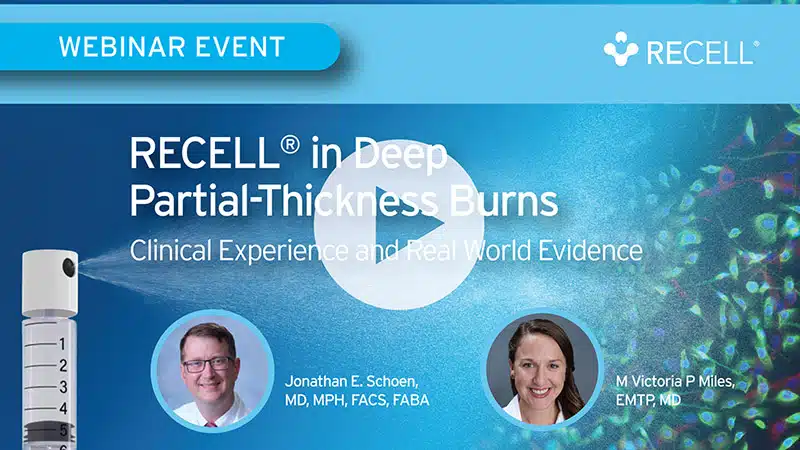
Deep partial-thickness burns present a common clinical challenge in burn care. As clinicians evaluate whether these wounds will progress, delays in definitive treatment can prolong hospitalization, increase treatment burden, and contribute to scarring and functional concerns. This webinar will highlight the role of RECELL® in the management of deep partial-thickness burns, drawing on clinical experience, case-based insights, and growing real-world evidence.
Join Dr. Jonathan Schoen and Dr. Victoria Miles as they share practical perspectives from their experience treating burn patients with RECELL, including cases that demonstrate rapid healing, functional recovery, pigmentation, and aesthetic outcomes. The faculty will also present new findings from the American Burn Association Burn Care Quality Platform (BCQP), illustrating how RECELL is associated with shorter hospital length of stay, increased patient throughput, and meaningful healthcare resource savings. Attendees will gain perspective on integrating RECELL into contemporary burn care while improving outcomes for both patients and healthcare systems.
Presenters:
Jonathan E. Schoen, MD, MPH, FACS, FABA, Medical Director, University Medical Center, New Orleans Burn Center, New Orleans, LA, Louisiana State University Health Sciences Center, New Orleans, LA
M Victoria P. Miles, EMTP, MD, Burn Surgeon, Louisiana State University Health Sciences Center, New Orleans, LA
Watch it on demand here:
Read the full transcript here:
Karen Winn, MSN, ACNP, RN
Good afternoon, everyone, and welcome to today’s webinar, RECELL and Deep Partial Thickness Burns, Clinical Experience and Real-World Evidence. We’re very pleased to be joined today by two burn surgeons from Louisiana State University Health Science Center and the University Medical Center of New Orleans.
During today’s discussion, they will share their clinical experience with RECELL and deep partial thickness burns, including case-based insights and real-world evidence that focuses on healing, functional and aesthetic outcomes and hospital length of stay.
Our first speaker is Dr. Victoria Miles. She is Assistant Professor of Surgery, Burn Surgery at the University Medical Center of New Orleans in association with LSU Health Science Center. Dr. Miles completed her general surgery training at the University of Tennessee College of Medicine in Chattanooga, followed by a Surgical Critical Care and Burn Fellowship at UT Southwestern and Parkland Hospital. She is actively involved in the American Burn Association and International Society for burn injuries, and has a broad research interest across burn care, including resuscitation, limb salvage, nutrition, and burn education.
Joining Dr. Miles is Dr. Jonathan Schoen. He’s Medical Director of the University Medical Center, New Orleans Burn Center. Dr. Schoen completed his surgical training at Osher Clinic, followed by a surgical critical care fellowship at the University Medical Center of New Orleans in LSU. After beginning his career primarily in trauma and critical care, he transitioned his clinical focus to burn care and now leads the UMC Burn Center in New Orleans, which is recognized as the 2025 Burn Center of the Year by the American Burn Association. We’re fortunate to have both of them with us today to share their experience and their perspectives. With that, it’s my pleasure to turn the program over to you, our first speaker, Dr. Victoria Miles.
M Victoria P. Miles, EMPT, MD
Hi everyone and good afternoon. We’re going be talking mostly about RECELL use and deep partial thickness burns today. We’ll start with our disclosures. I feel like most people normally skip over their disclosure slide pretty quickly, but Dr. Schoen and I like to emphasize that in New Orleans, we do things a bit differently.
While we consult and speak for a few companies that we’ve all agreed upon as a group, all of our compensation is directly donated to local burn charities by the company to support outreach, education, research and survivor programming. It’s how we support our survivor program. So in the products that we choose to speak for, we choose them because we think that they work and we have good experience with them. So we’ll be speaking to that today.
The picture there on that slide is actually a scar print workshop we did with our burn survivors that was funded by some of these proceeds where the patients were able to do art prints of their scars and that’s actually the print they made for our clinic space so that hangs up in our clinic space.
Many of you are familiar with the three technologies that AVITA offers. PermeaDerm is a temporary skin substitute for early wound coverage. Cohealyx is a skin substitute for further along in the wound healing process, and finally RECELL. So we’re going to be talking about RECELL, or skin cell suspension autograft, for deep partial thickness burns today, primarily.
Focusing on RECELL, we wanted to start with a couple examples of wounds that we’ve treated here in New Orleans. Obviously we treat a lot of patients with higher Fitzpatrick cell skin. And these are just a few examples of our patients and some case studies that we’re going to be showing you today, but I think as we go through, how would you treat these wounds in your practice and how might you alter that algorithm?
When we think about deep partial thickness burns, you stop and think that there are two different approaches which have been undertaken to manage these wounds, at least historically. The first one is to immediately graft all of these wounds. But we know if early on you graft your second degree wounds, that you can risk over-grafting and taking too much donor skin. Donors are painful as we all know, it’s the most painful part of a burn procedure in most cases. So we want to limit how much of our second-degree burns that we end up having to graft.
But I think the other take that people have is, well, with second-degree burns, we can wait and see. We can wait and see if it heals. Most second degree wounds, even deep second-degree wounds, ultimately will heal. But what we know is that the longer it takes for those second-degree wounds to heal, the greater the likelihood there is that the patient will develop hypertrophic scarring with that inflection point being somewhere around, depending on what paper you read, two to three weeks into the healing process. And if you have deeper second-degree burns, it’s very likely to take two or three weeks for those wounds to heal. So the patient is left with a wound that is not only painful for two or three weeks, keeps them out of work for two or three weeks, but then ultimately develops hypertrophic scar, which can be functionally limiting as well as have cosmetic issues.
I talk to people a lot about this. I think it’s really important to point out that I believe, in 2026, that our goal in burn care is no longer wound closure. So if you’re focused as wound closure, I think we’ve all moved beyond wound closure. There are many things we can do to get a wound to close in 2026, and I’m not trivializing that, but my focus now is how do I get the wound to close. And close in a way that the patient is not functionally limited, closed in the way where their wounds are not cosmetically noticeable.
Ultimately my goal is to have a burn patient be able to go to the grocery store, go to church or take their kids to school and no one to be staring at their scars and for them to be able to perform all of their activities of daily living. I think our goal 20, 30 years ago was to get the wound closed, but now our goal is “how do we give that patient wounds that do not limit them in the future?” RECELL gives us an 80:1 expansion. You take a skin biopsy, it’s in a heated trypsin bath on the back table. In a sterile procedure, we get an 80:1 expansion of spray-on skin, per se, is what we often hear people say.
And there’s multiple benefits to utilizing RECELL, especially for deep partial thick mid-burns. You can treat early without committing the patient to large donor sites. You can often avoid traditional grafting for much of your second-degree wound. And then as I mentioned in New Orleans, we treat a lot of patients of higher Fitzpatrick scale skin. RECELL offers us one of the only ways to repopulate melanocytes and provide the patient with significant skin pigmentation. We also have many, many studies to show that the use of RECELL reduces hospital length of stay, which makes sense if we’re able to treat these patients earlier and not use a watch-and-wait methodology in treating these wounds.
This is an example of a guy who was a water meter reader, and there was an arc flash, there was actually a flame burn that he ultimately sustained from a work-related injury. He was treated in our center. He’s 32 years old, 20% wound. And we treated his face with RECELL alone while the rest of this area, there’s 2:1 mesh graft on his neck and then a wider mesh graft further down. But as you can see, he has significant early repigmentation at just 13 days post-op. And then here at 16 months, you can hardly tell that he was even burned to his face, which again, in 2026 is ultimately our goal. We’ve transitioned our protocol in New Orleans.
I think, you know, a lot of us will note that often we put off faces. So we’re like, “I hope this area of the face will heal,” especially in our bigger burn patients. So “I hope that this area, the face, will heal. I hope I don’t have to operate on this face, this portion of the face. I don’t have to excise this portion of the face,” but we’ve transitioned our protocol here where we will use enzymatic debridement of the face at the initial excision to help get the burn off of the face and go ahead and spray the face with RECELL at the time of their initial excision in our big burn patients.
So this was a 35% burn patient. This was sustained in an apartment fire. He received enzymatic debridement on the treatment day which is about post-op day four or five. And then here he is at 25 days post-op with significant repigmentation. Now he’s almost at a year out, and again, difficult to tell that he was even burned on his face. As many of you know, there’s very little evidence to support a lot of what we do in burn surgery. However, there is a lot evidence to support the use of RECELL skin cell suspension autograft with over 200 publications, and many, many randomized controlled trials. And those have only increased in the last few years.
When we think about treating deep partial thickness burns with RECELL, our approach in New Orleans is to try to operate as soon as we can in those patients and as soon is feasible, and then to excise the burn. If we are down to reticular dermis, and I describe reticular dermis as when we see fat coning, but a very thin sheen of dermis with significant amount of fat poking through the dermis, then in those areas we will place small areas of skin graft. If we’re more superficial than that, then we commit ourselves to RECELL alone.
Utilizing this approach and in studying the use of RECELL and deep partial thickness burns, we’ve seen that of 98% almost reduction in donor skin. We graft those deeper areas where we’re down to deep reticular dermis where we see fat coning. And then use RECELL for the other areas that are more superficial. And we also spray over the meshed autografted areas as well. We know that RECELL significantly reduces our donor site size, which obviously reduces pain and then long-term scarring, and that’s been proven.
In terms of what RECELL actually is, after your skin biopsy is put into the heated trypsin bath, we get your, then you’re breaking down that piece of skin into cellular components. Millions of fibroblasts, keratinocytes and melanocytes, which interestingly are the melanocytes and the ability to provide repigmentation to patients, which we really didn’t have an option for that until we had the RECELL technology. And what we see, this is an example of a sprayed, meshed autograft. What we see at the interstices is you have keratinocytes populating this area and filling in those interstices with re-epithelialization pretty early on. So you’re not only growing from the borders of the graft, but you’re actually filling in those areas where you’ve sprayed those more widely meshed autografts. In using RECELL alone for deeper partial thickness burns, you can see re-epithelialization very early, sometimes between day five and day seven.
This patient was over 95% re-epithelialized at day seven and then returned to work two weeks post-op. Remember, historically, had we treated this patient’s wound with serial dressings, you may be doing dressing changes until the three-to-four week mark, and then also putting the patient at risk for hypertrophic scarring. We also see this is an engineered dermis with keratinocytes versus with RECELL. As I mentioned, the melanocytes are of significant interest to me and actually in doing a project right now, developing a project in conjunction with a few other centers where we’re trying to show the significant repigmentation that we see with RECELL with a meximeter, but you can see proliferation of the melanocytes there on that engineered dermis when RECELL is utilized at day 21.
Finally, we had three patients that came in that were all involved in a recycling plant explosion. You may wonder why in the world we would take donor sites from the patient’s forehead, but that was actually where his helmet was on his face. There was a band across the helmet, so that was the helmet strap there on his forehead. That’s not a donor site. But I used RECELL for this patient. And I think what’s significant about this case is if you’re an early user of RECELL, some patients will repigment very quickly, others it takes a little bit longer to repigment. You see here at 27 days post-op, still without significant repigmentation, but at eight months, significant repigmentation.
I know Dr. Schoen and I both counsel our patients on the importance of watching and waiting up to 12 months. You’ll see continued repigmentation in our darker Fitzpatrick scale patients. With that… I’m going to turn this over to Dr. Schoen in the interim. If you have any questions or thoughts, please feel free to place those in the chat.
Jonathan E. Schoen, MD, MPH, FACS, FABA,
I’m glad you mentioned that, Victoria, because we have a patient right now in our burn unit that got a very similar treatment, who just asked me on Friday about skin repigmentation. I was able to show him some of our educational cases, de-identified, of course, of you know, this is what we think it will get to. Of course, making no promises to him.
So transitioning away from the sort of the micro view of this use in these cases, backing it out, looking at the 10,000 foot view of the macroscopic assessment of what we’re doing with skin cell suspension autografting and data that we can really only look at when we have a very, very large number of patients. Which fortunately, with the development and the advancement of the Burn Care Quality Platform (BCQP), we’re finally able to look at these kind of interventions on that 10,000 foot view.
So we’ve seen the upscaling and the usage of RECELL growing from when it hit market all the way up to more recent years and only accelerating into ’25 and ’26; I don’t have that data presented on this slide. But now we’re up to over 100 centers using RECELL, and of that 111 centers that are participating. So again, the vast majority of the higher level burn care that’s happening, that we’re growing the Burn Care Quality Platform to be further reaching to all burn centers, there are all centers that are participating in burn care. But I do think that that’s indicative that 111 that are the biggest adopters of this platform, a hundred of them are utilizing it.
Utilizing that data set, we’re looking towards real world data. Real world data being much more powerful and compelling than even multiple randomized control trials, because we’re not looking at things as they happen in a controlled environment; we’re looking at what really happens in the real world where factors can be balanced but not necessarily controlled and removed.
The Burn Care Quality Platform registry queried from 2019 to 2024, looking at adult patients greater than 18 years of age who got either split thickness skin grafting or RECELL alone for their deep partial thickness burns and tried to remove confounders from that. We took patients that were non-thermal injuries, patients that were traumatically injured, patients that were length of stay outliers and patients ultimately where their disposition was deceased or to hospice.
So that matched 741 patients, which gave us about a two-to-one ratio of 494 in the split thickness skin grafting group and 247 in the RECELL group, matching a two-to-one ratio of sex, age, TBSA bands of 10% and presence or absence of inhalation injury. With that, looking at that data set that was created, we saw an average of 5.6 days reduction in length of stay, which is about 36%. Utilizing earlier studies, we were able to extrapolate that into about a $42,000 savings.
Furthermore, what we saw with these patients was a reduction in patients that were discharged to other care facilities, which is, of course, a lesser, easy to detect, sense of cost to the healthcare system. But we do know that’s an additional cost. If we can reduce someone’s further care that they’re requiring, another way to do that is looking at secondary interventions, which is some research that’s ongoing. But what we saw was these people were much more likely to go home. That is a lower cost to be the care environment. That’s in addition to the cost that we’re looking at within the hospital, which was about $42,000 saved. That equating to about 13 additional patients per year.
At our center, championed by Dr. Miles and our third partner, Dr. Carter, we do a lot of work with the Department of Defense. And so we worry about capacity for sustaining care when we are overrun with volumes of patients. The increased capacity that RECELL in this technology affords us is something that we’re very interested in, both at our center and the government is very interested as well. These studies up here, there several of them culminating in Dr. Miles’s study at the bottom from 2025. But again, this has been reproducible, repeatable data. And again, culminating in the best set of data that we’ve ever had to look at for this with the Burn Care Quality Platform. The rest of these we’re looking at as a case series in the reduction. So again, culminating all the way at the highest level, the best evidence for real world data on this.
This was a case, as you can see, it’s actually another one of Dr. Miles’ fine aspects of work we’re discussing in this presentation. This is a young lady who had a very significant skull burn to her scalp. We were looking at ways in which we could try to give her the best outcome from an ability to regenerate her hair without having nested hair follicles, putting a skin graft over it, without having to overexcise areas. So we combine the ability of the precision of excision that we can do with enzymatic debridement with the technology of RECELL to implant very specifically locally, not over over hair follicles as can happen with split thickness skin grafting. And again, because that nested hair follicle and all of the secondary interventions that are going to be required later on to remove those hair follicles or destroy those hair follicles, or deal with all of the other problems, the small abscesses that can occur.
So again, the Burn Care Quality Platform, looking at this from a registry standpoint, growing that cohort, now we have up to 125 burn centers that are participating in that. You can see Dr. Miles’ study again at the top of the list. Other national analyzes that have been done, there was another one looking at the national analysis of skin cell suspension autograft in burn centers and the reduction of costs with that, the reduced mortality also, and all of these were published in JBCR. So, you know, the pinnacle of burn care research there.
The company has shown across the board here the ways in which they’re going to support us as burn practitioners, the development of further burn care, and then on a case-specific basis, ensuring that we have good access to care, good medical education occurring across the board, whether it’s intraoperatively, APPs and surgeons in the OR, surgical techs, if they’re part of your team that’s preparing your autografting and helping you get through the case there, all the way to the post-operative care, working with your therapists, your nurses, patient care technicians, your follow-up in your clinic, all aspects of care that are supported by the medical education. And then patient access, of course, very important, very helpful, the ways in which AVITA is supporting us through that.
So, coding for RECELL, there are new codes. All this information that we’re going through here is going to be fortunately outdated very soon. However, at the moment, the codes that we have for harvesting is 15011 plus 15012* for additional areas of harvesting of skin for preparation. Once you get past four six-square centimeter biopsies, you’re into the next code at 15012. And then from there you have two options. You can go with the manual preparation, 15013 and 15014, up to automated as your other avenue for doing this. That is a CPT code of 17999. So again, that’s either or can’t utilize both of these and then application — applying the skin cell suspension autografting by spraying or drizzling onto the wound bed there. And then applying the primary dressings, all part of the 15015 to 15018 codes that you’re gonna be doing.
In addition to that, for RECELL GO, we’ve got the HCPCS codes that are in there at C8002 and C1832. AVITA’s put together some coding and reimbursement guides for you that are incredibly helpful, especially as these codes are changing, but nonetheless, you have your coding guide there at that QR code, and as I mentioned, tremendous clinical support from the AVITA folks here, both through your local reps, through your educational team members that that go out to the facilities as well.
But specific questions about coding, coverage, and reimbursement, you can see the email address there. And then patient access questions, you have that other email address there as well too.
So, RECELL, and this is in our minds and the minds of many burn practitioners, really has redefined the ways in which we’re going to be dealing with deep partial thickness burn care. Again, Dr. Miles covered this very well. No more wait and see approach on this and figuring out what exactly is going to heal and what’s not. That’s going to expedite your care, reduce donor size and pain. This has been repeated in the literature.
It also is just plain logical if you’re doing an intervention that has an 80:1 expansion ratio of coverage of someone’s wound and you’re having equivalent or better outcomes, and you’re not putting down a 2:1 or a 3:1 meshed skin. That is going to be fewer donor sites or smaller donor sites, and the reduction in pain, and reduction in wound care, and a reduction of some degree of disfigurement that occurs with taking unharmed skin from elsewhere on a patient. You’re going to have faster donor site healing, again, that is one of the ways in which we mitigate the changes that are going to occur when people get donor sites as we’re going to be spraying them. Better aesthetics, again that has been repeated in the literature.
Dr. Miles showed you a couple of cases there where we’ve had just tremendous outcomes both in patients that have had enzymatic debridement and in the pre-enzymatic debridement era of our care. And then reduce length of stay as we touched on with the burn care quality platform data sets there. So I wanted to thank you all for your attention. I wanted to thank our friends at AVITA for providing this opportunity to my awesome partner, Dr. Miles and myself. Because without these opportunities, without you all in attendance, we don’t have AVITA and other companies when we do engagements like this, making donations to our burn survivor fund that allows us to do things for our indigent and uncovered and uninsured patients and sometimes uninsurable patients with a lot of our patients being undocumented at our facility.
But in addition to that, we do our burn survival programs and we do our unfunded research. But when Dr. Miles and I are riffing in our research room and come up with a great research idea and we don’t have a good way to cover it, we utilize these funds to do that. And we’ve had some pretty great advancements that we’ve been able to enact through those funds and those thoughts. So thank you all.
And now I believe we’re onto Q&A. So: What are the CPT changes coming in 2027? So we have one partner and two extramural partners that work very, very hard to get us codes that will allow us to be appropriately compensated for the work that we’re doing. Dr. Carter, Dr. Travis, and Dr. Holmes have worked very hard, working with the CPT committee and the RUC committee and the AMA in order to get codes assigned. And so those codes will be coming out in January of 2027. I don’t believe they have numbers assigned to them yet.
We got a question in the chat relayed from Karen: Beyond the clinical benefit to the individual patient, what does reducing the length of stay potentially mean for a busy burn center in terms of bed availability, patient throughput, staffing, and overall resource utilization? Yeah, I mean, it could be totally game changing. If you’re utilizing this technology on a large number of your patients and you’re especially in a larger volume burn center, the increased capacity that that can afford you to take in more transfers that would otherwise stay out in the community getting perhaps not expert care could be very impactful. And then, you know, as I touched on briefly, disasters and conflict, large-scale conflict. The capacity to take care of more patients more effectively and efficiently because you’re moving people through the continuum of care more quickly can be really impactful and really beneficial to again getting onto the next patient that needs your help.
M Victoria P. Miles, EMPT, MD
There’s another question about what kind of dressings you use on top of RECELL. So we keep it pretty simple here in New Orleans. The Telfa Clear is provided in the packaging, at least in the U.S. So you’ll have the Telfa Clear not adherent layer. And then we use Xeroform, some type of fluff or 10-ply dressing or burn pad, followed by Kerlix and then compression and A-strap. Or a burn netting, either one, depending on what part of the body that you’re working on. For the faces, we do a Telfa Clear layer. We secure the Telfa Clear layer with chromic sutures and areas where they would not be as noticeable. So at the corner of the nose here, behind the ear, underneath the jaw, we’ll secure them where you won’t see suture scars in the hairline, and then do Xeroform tin ply that’s cut with eye holes and mouth hole and nose holes. And then netting for the face. So that’s what we do here.
I think it’s, that’s about as simple as you can get. And in terms of RECELL for management of those dressings, we change everything except the Telfa Clear every 48 hours. And then we start removing the Telfa Clear at day seven after the procedure. Although I will say if the Telfa Clear is fairly adherent at day seven, that likely means that the re-epithelialization is not complete. We don’t want to disrupt that. So we will trim around the areas where it is adherent and let that re-epithelialization continue to occur. So if the Telfa Clear is very adherent then it’s probably just still re-epithelializing.
Another question: Can you expand on enzymatic debridement prior to RECELL application? I can expand on that. So we’ve presented these findings at Southern Region Burn. This idea actually came from when Dr. Carter, our partner, the immediate past president of the American Burn Association, went to the Australian New Zealand Burn Association meeting. I want to give them credit. In Perth, they were using these technologies together and brought this back to Dr. Schoen and I who, admittedly, were a bit skeptical at first until we’ve seen some of these outcomes.
We’re waiting on a series of about 15 of these patients before we publish. We’re over 10 at this point, and you saw some of those today. So I did my fellowship at Parkland. There’s a tendency there, and then I think a tendency here where we were, as I alluded to, we kind of waited on the face in our big burn patients, waited on it to declare. It’s more intricate work as we all know. So, tend to put that off until a little bit later. And we found out that that was holding up our length of stay in some cases. And we’re really proud that some of our big burns, at least our institution, get out at less than one day per percent TBSA and try to push the envelope on that. We’re also able to accomplish that because it’s not uncommon that Dr. Schoen, Dr. Carter, and I all operate together on a single patient. And so… Our algorithm was that the patient was excised within the first three to five days, just dependent on their clinical state. So completely excised within the first three to five days.
We then would go into a temporary substitute such as PermeaDerm. So temporary skin substitute that gets transitioned to a more permanent skin substitute dependent on the patient’s stability around day seven, and we then move into grafting with some of our big burns of 50, 60 percenters only having three, four cases, honestly, just depending on the donor size. So we integrated enzymatic debridement at the initial excision into our algorithm. So at the initial excision, one of our surgeons is just dedicated to the face. At time of general anesthesia, we will place the enzymatic debridement agent on the face, and then we just do irrigation when we complete our excision and we do irrigation and then it’s about a debridement agent and immediately use RECELL for the face. And we’ve seen excellent results.
I think in terms of the face, you can quote unquote, “get away with using RECELL alone in a lot of areas,” just because the face I believe is so well vascularized that it’s more likely to heal with RECELL alone, even when you have some deeper areas. It’s not true for very deep third degree burn of the face. I know that’s not lost on anyone, but you can see from our images that we showed you today, there’s some pretty deep partial thickness burns of the face that we’re able to see good scar outcomes. I think it’s probably because we’re treating them so early and getting the burn off so early, but good scar outcomes with excellent repigmentation.
And for a question about dwell times: We don’t like to speak a lot about about dwell times. I would say that, as you know, the dwell times are three hours but as soon as we’ve finished excising and placing skin substitute we don’t prolong our case just for dwell time is my answer to that question.
Jonathan E. Schoen, MD, MPH, FACS, FABA,
I want to say the range on it, I have to double check this, I think it was 55 to 140 minutes, I believe. I have to double-check the case series. So we’re not even getting close to the necessity of the duration for enzymatic debridement per the package. And that was part of the research that Dr. Carter learned about at ANZBA.
And shame on me, I cannot remember the name of the surgeon who presented that. I’ve been looking it up while Dr. Miles is talking, but that’s unfair of us. And I’ll get that and I’ll ask the folks to distribute it because she deserves the credit.
Another question came in: How would you handle a patient with just partial thickness burns that did not require excisional debridement? So regardless of what you’re looking at on the wound bed, there is going to be some degree of biofilm and other detritus of the wound that you’re going to need to get off of that wound bed prior to spraying with RECELL. So typically the ways in which we’re doing that, it could be a vigorous, you know, scrub brushing to do that, to get that bioburden sort of removed. It could be utilizing hydrosurgical excision devices or mechanical tangential excision devices like we typically use the dermabrader drill in those instances.
But even when the wound bed doesn’t have anything directly visible on it that would appear to be something that needs a sharp excision, you do need that wound bed freshened up, and you need that ability of that exudative fluid flow going through the wound bed in order to support the skin cells as they dissipate the buffer solution that they’re sprayed into.
[New question response] So enzymatic debridement is not, we’re not really utilizing as a pre-cleaning method because the first step on the enzymatic debridement when we have them in the operating room is we are getting off any pseudo-eschar or desiccated eschar per that product. If you’re staring at, you know, leather, the thickened skin, you need to do something to get that off in order to apply the product to work its way through, sort of, the wet burn tissue. I know Dr. Wong, who’s a big user of enzymatic debridement at UAB, he’ll typically checkerboard dense eschar. So similarly, if you have someone with pseudo eschar on their face and the dried and crusted material on there, that’s the first step. And you can see in Dr. Miles’ pictures she shared earlier, we weren’t looking at that as the initial picture of the wounds and the intraoperative pictures. That was coming off. Then we were applying the enzyme. Then we were looking at the degree to which the enzyme succeeded in excising the wound bed, getting us down to a well-perfused healthy-looking wound bed. And then we’re applying the skin cell suspension.
And again, to her points about the ways in which that expands our capacity, this is functionally something that you could do at the beginning of the case. Put the enzyme on. If you have someone in a supine position, leave them just like that.
Yes, Helen Douglas. I see it in the comments. Thank you so much for looking that up. She was the one who presented that case. The case series that Dr. Carter brought back to us and said, wow, I think this is the next best thing. So thank you for looking that up.
M Victoria P. Miles, EMPT, MD
And there’s a question about when you’re evaluating a deep partial thickness burn, key clinical factors that make you decide a patient is a good candidate for RECELL alone rather than conservative management or autografting. So as I mentioned, we know that most deep partial thickness burns will eventually heal. We know that to be true. It could take, in some patients, months, but will eventually heal. If a patient has a prohibitive operative candidate, we’re risking their life for taking them to the OR for RECELL. And obviously we would lean towards conservative management.
For someone who is a reasonable operative risk, then we would definitely consider for larger surface area, second degree burns, utilizing RECELL to decrease our length of stay for that patient and to decrease their time to healing, to decrease the chance that the patient will develop hypertrophic scar, and to improve their overall pigmentation outcome.
I think the second question is a different question as compared to traditional autografting. So we use this, Dr. Schoen and I, and Dr. Carter, use this combined approach for second degree wounds. We will either dermabrade or use hydrosurgical debridement. Many people use a VersaJet and delineate what level of the dermis is affected. If the majority of the reticular dermis is lost, then in those cases where you see that fat coning, like I mentioned, we will do a more widely meshed autograft than we normally would, with RECELL sprayed on top of it in very deep second degree burns, and then use RECELL for the remainder of the wound. So we will mark out exactly where we need to graft. So we use this kind of combined approach but use RECELL for the entirety of the wound and the donor in that same case to expedite our healing time. But we’re using more widely meshed autograft for very deep second degree burns where we’ve lost the majority of our reticular dermis and see a large degree of fat coning as well is basically our approach.
Question: Going back to the patient with just partial thickness burns, are you performing enzymatic debridement on those patients prior to RECELL? We only presently do that for the face and head. So those are the only times we do that. There is an economic perspective to utilizing enzymatic debridement, the health economics perspective to take into consideration. And so right now we utilize enzymatic debridement with RECELL in combination for face, scalp, essentially.
Jonathan E. Schoen, MD, MPH, FACS, FABA,
Given the added cost of doing that, we hold it in reserve for those patients or for patients that are very poor operative candidates. That’s not a dig on the technology. I think it’s wonderful technology — but we’re a safety net hospital where we have to be extremely cost-conscious.
Question: Thinking back to when you first began using RECELL, compared with how you use it today, what have you learned from experience has changed: patient selection or treatment approach? We’re more aggressive with depth than we were before. You know, it used to be superficial, partial thickness, maybe touches of deep partial thickness you would do this on, but now we’re far more aggressive into the deep partial-thickness utilization of it. We’re also more akin to putting dressing on people and securing it in a way that will not necessitate them staying in the hospital, because we’ve developed an understanding of how much we are improving our ability to control patients’ pain through their post-operative wound care because their donor sites are smaller. And so we’re much more likely to put the dressing on somebody, secure it with Dermabond or suture it to itself, particularly in extremities, and dress it and get the patient out of the hospital before they get that seven-day primary dressing takedown. Early in our usage here, everybody that was getting RECELL was spending all seven of those days in the hospital; whereas now we’re regularly discharging people if we deem that they’ll be able to do the secondary changes and that they’ll be able have a primary removal in clinic.
Okay. I don’t see any more questions. Well, thank you again to our friends at AVITA. Thank you for providing this technology that’s been so impactful to help our patients. Thank you for opportunities just like this one for my partner Dr. Miles and I to get on here and talk about it and for the support that you all give us for our burn survivor fund.
*These codes will change effective January 1, 2026
PRO-2750-v1